About Agora
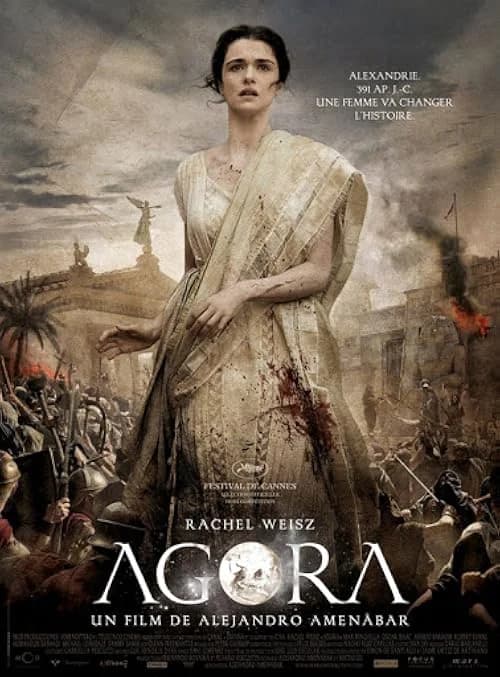
Agora (2009) is a visually stunning historical drama that transports viewers to 4th century Roman Egypt during a time of profound religious and intellectual upheaval. Directed by Alejandro Amenábar, the film centers on Hypatia of Alexandria, a brilliant philosopher, mathematician, and astronomer played with captivating intensity by Rachel Weisz. The narrative unfolds against the backdrop of a city torn apart by rising religious conflict between pagans, Jews, and the increasingly powerful Christian sect.
The plot masterfully intertwines Hypatia's dedication to science and reason with the personal story of her slave, Davus (Max Minghella), who seeks freedom through the new Christian faith while harboring a deep, unrequited love for his mistress. As the Library of Alexandria comes under threat and mob violence escalates, the film becomes a powerful meditation on knowledge, faith, and the tragic clash between enlightenment and fundamentalism.
Amenábar's direction is both epic and intimate, creating a richly textured world that feels historically authentic. The cinematography and production design are exceptional, bringing ancient Alexandria to vivid life. Weisz delivers a career-defining performance, portraying Hypatia's intelligence, vulnerability, and unwavering commitment to truth with remarkable nuance. The supporting cast, including Oscar Isaac and Michael Lonsdale, adds depth to this complex tapestry of characters.
Viewers should watch Agora for its timely exploration of the tension between reason and faith, its breathtaking visual scale, and its poignant human story. It's more than just a historical epic; it's a thought-provoking drama about the preservation of knowledge and the courage to stand by one's convictions in the face of overwhelming opposition. The film's themes resonate powerfully in today's world, making it an essential watch for anyone interested in history, philosophy, or compelling cinematic storytelling.
The plot masterfully intertwines Hypatia's dedication to science and reason with the personal story of her slave, Davus (Max Minghella), who seeks freedom through the new Christian faith while harboring a deep, unrequited love for his mistress. As the Library of Alexandria comes under threat and mob violence escalates, the film becomes a powerful meditation on knowledge, faith, and the tragic clash between enlightenment and fundamentalism.
Amenábar's direction is both epic and intimate, creating a richly textured world that feels historically authentic. The cinematography and production design are exceptional, bringing ancient Alexandria to vivid life. Weisz delivers a career-defining performance, portraying Hypatia's intelligence, vulnerability, and unwavering commitment to truth with remarkable nuance. The supporting cast, including Oscar Isaac and Michael Lonsdale, adds depth to this complex tapestry of characters.
Viewers should watch Agora for its timely exploration of the tension between reason and faith, its breathtaking visual scale, and its poignant human story. It's more than just a historical epic; it's a thought-provoking drama about the preservation of knowledge and the courage to stand by one's convictions in the face of overwhelming opposition. The film's themes resonate powerfully in today's world, making it an essential watch for anyone interested in history, philosophy, or compelling cinematic storytelling.